
Before we can get to the theory we have to talk about some background psychology. First, we’re going to talk about what I believe to be the most important book about political psychology. It is a book that makes you rethink how our brain works, how our mind works, how the process works when we think about politics, but more importantly when we think about morality, when we think about questions about what is right and what is wrong. And the book I’m talking about is The Righteous Mind by Jonathan Haidt. In the book, Jonathan Haidt explains the intuitionist model of morality. That model is going to be very important later because we’re going to look at the survey results and interpret them using this model.
But what exactly is the intuitionist model? I think the best way to explain it is with examples. I am going to use two examples for moral questions.
- Is it wrong to tell racist jokes?
- is it wrong to have gay and trans characters in kids movies?
These are examples for questions about morality that left-wing and right-wing today cannot agree on. There is still a divide on these issues. People on the left, by and large, say that it is wrong to tell racist jokes. And people on the right, by and large, say that it is wrong to have gay and trans characters in kids movies. That doesn’t necessarily mean they want the government to do something about it. They wouldn’t say that it’s legally wrong, but they would say that it’s morally wrong, ethically wrong. And of course, this doesn’t apply to every single person who identifies as liberal or conservative. But I would say this applies to the vast majority of people. If I had to put a number on it, I would guess about 90%. If somebody tells you what they’re position on both of these issues is you would have enough information to guess whether they’re liberal or conservative with about 90% accuracy. Not 100% accuracy, because there will always be exceptions but 90% is still pretty good.
Now, our brains must have done something to derive at those opinions. There must have been some kind of underlying process that is how that we decide whether something is right or wrong. And that process is what I want to talk about.
One possible way that you can imagine our brain working is that when we are confronted with a question like this, and what I mean with a question like this is any kind of moral dilemma where we have to decide whether something is right or wrong. We think about, what would be the consequences of that would be? If someone tells a racist joke or has a gay character in a kids film, what would that lead to? Does it have a positive impact or a negative impact? Then we start thinking about the arguments you could make. How could you argue that this leads to harm? And also, how could argue that this does not lead to harm? And based on which side, according to our mind, has the better arguments, we make a decision whether something is right or wrong. I’m going to refer to this model from now on as the logic model of morality, because it posits that we make our decisions only based on facts and logic. We look at the facts first and then come to a conclusion.
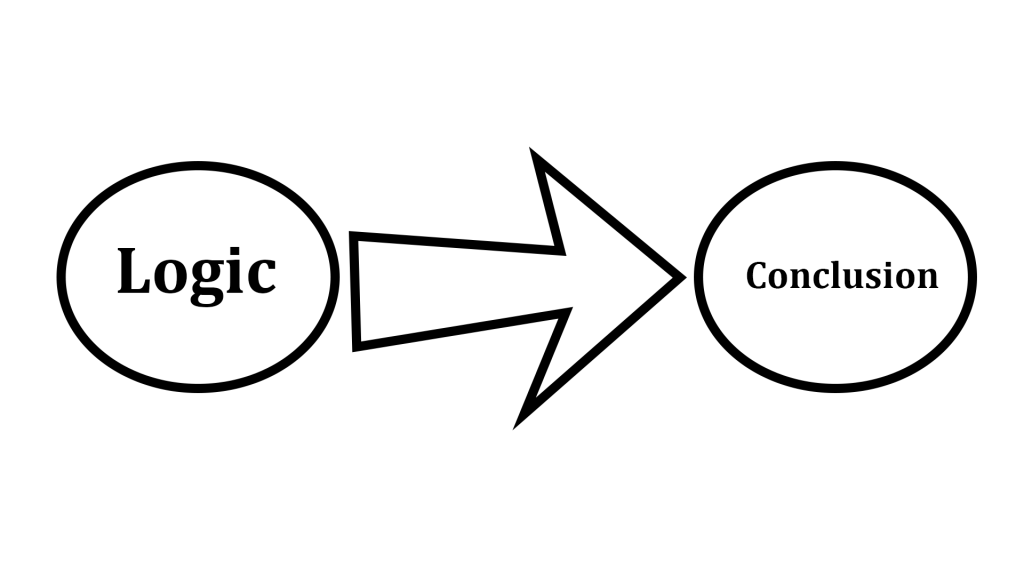
And the logic model would posit that the difference between liberals and conservatives lies in which arguments they find more convincing. An argument that could convince liberals would be for instance that racist jokes are dehumanizing. They’re meant to show people that people of different races are less than. That they’re beneath white people. And an argument that could convince conservatives would be for instance that gay characters in kids movies are grooming. Maybe not necessarily grooming people into becoming gay, but grooming them into an ideology.
I would say that this is how most people view the world. That politics is about different how one could argue for each side. But I would say that most people who have a little bit of experience with the left-right debate must’ve realised that that can’t be all there is. There must be something more to that, something that isn’t 100% rational. And that is true. I’m going to go so far as to say that a species that was always completely rational, that only cared about facts, logic and arguments, would not have a left-right divide.
I think I can show that with an example. Imagine we would know everything. Imagine we had discovered everything that human beings could ever discover. Imagine we had one hard drive where all the knowledge of the world is saved. When I say all the knowledge I mean all the knowledge that is possible to have, I don’t just mean everything about politics or everything about history. On that hard drive is saved everything that is happening now, everything that happened in the past, and everything that will happen in the future. And everything that happened in any parallel universe. So if somebody makes the claim that jokes lead to racism or gay characters lead to grooming, we could look into every single parallel universe where that happened or didn’t happen and definitively say if that is true.
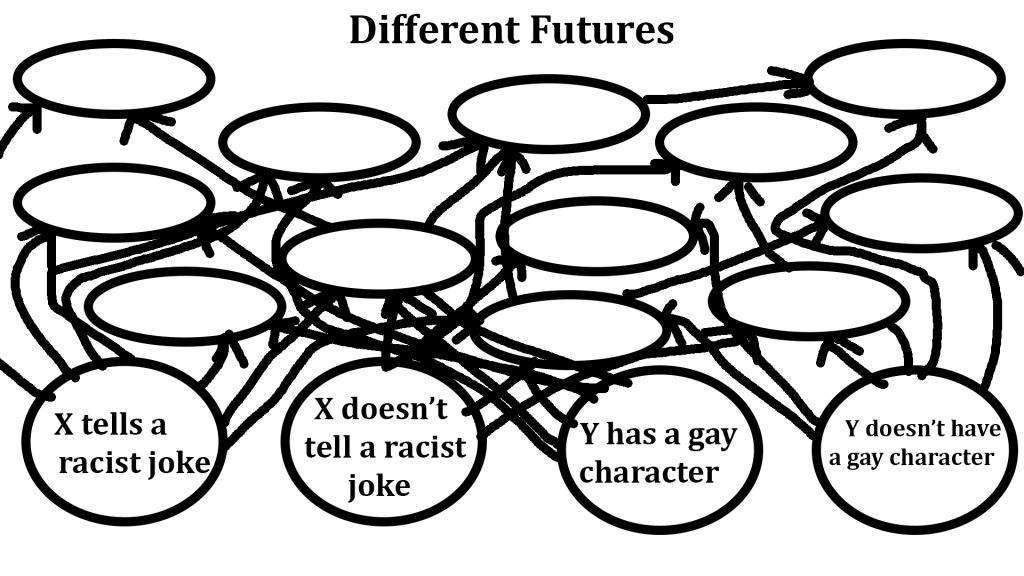
If the logic model was true, that would end all discussion. If all we cared about were the facts, the logic, the arguments and whether something has positive or negative consequences the debate would be over. We would simply look it up on the hard drive, come to a definitive answer and nobody would have any reason or any justification to disagree with that answer.
People who defend the logic model would say that of course we don’t have that kind of hard drive. The reason people disagree is because they have different forms of background knowledge.
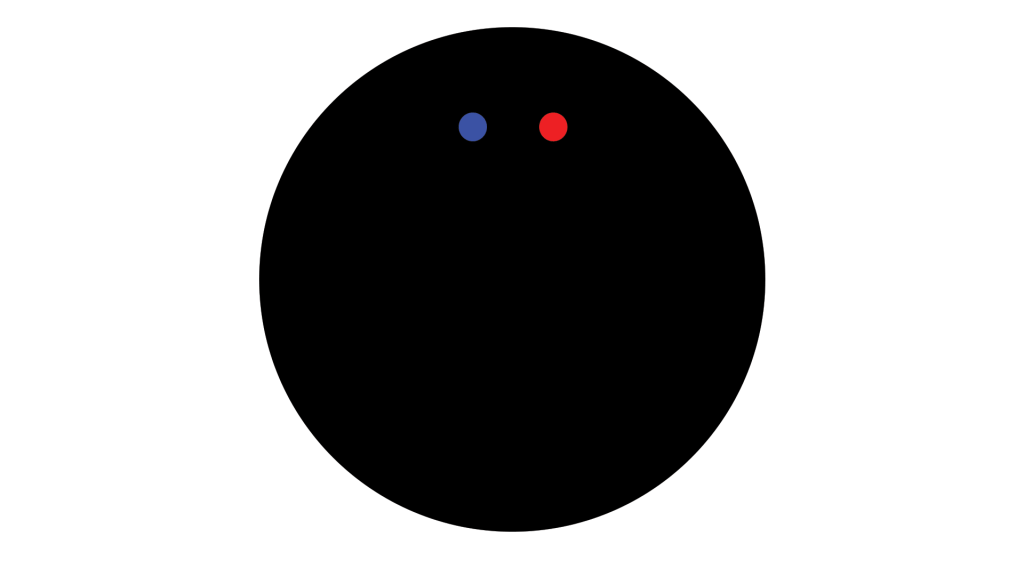
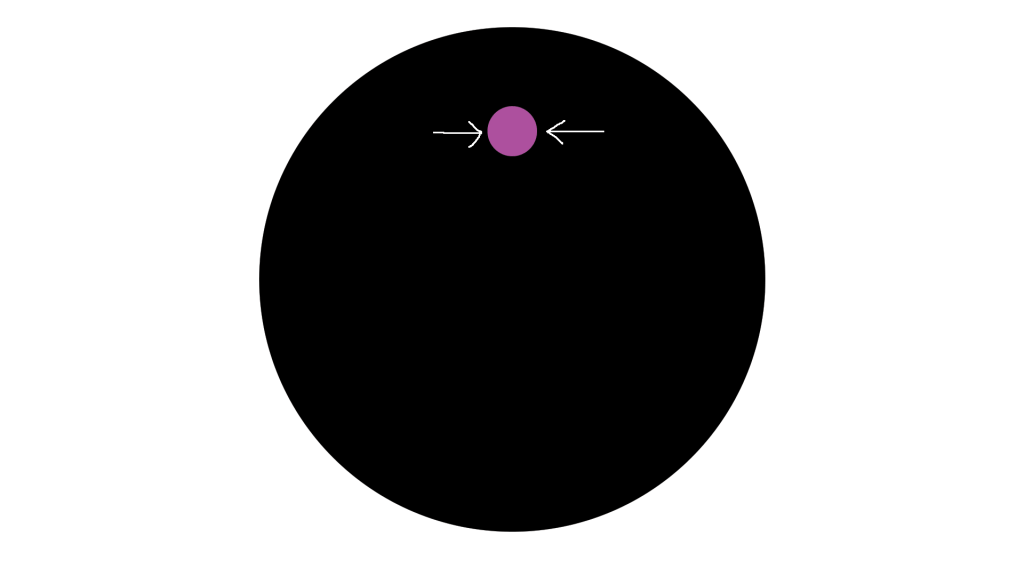
So let’s imagine that this big circle would be everything that is listed on the hard drive. This is all knowledge that would be possible for humans to have. And the tiny circles would be everything that a given human being knows. That is all the knowledge that one person has. And by knowledge I don’t just mean factual knowledge, I mean any kind of form of knowledge. I mean life experience, I mean thought experiments that they made, what they know from their ideology or from their religion, etc.. All of that is in this tiny circle.
According to the logic model the reason these two people disagree is because they have different circles of knowledge. Now what should happen if they both debate? Presumably each one of the two would share their knowledge with the other person. And again I’m defining the word knowledge very general here. They would tell them why they believe what they believe and that would widen the circle of the other person. And the logic model says that the reason the other person isn’t convinced is because they judge new knowledge by the background of knowledge that they already have. For instance if one of them says racist jokes are dehumanizing or gay characters are grooming, maybe the other person never saw that happen, never saw somebody be dehumanized or groomed. And therefore to them this idea sounds unrealistic. Maybe they even saw something that would contradict that. Or maybe their ideology or their religion would be against that. If the logic model was true, if facts were the only thing that we care about, what would then happen is they would have a debate about their underlying knowledge, about their knowledge that contradicts that. If life experience is the issue they would then share their life experience. If the issue is ideology or religion they would then have a debate about if that ideology or the religion is true. If we were all completely rational, what would happen over time is that these two circles would become one circle. And according to the logic model if two people’s circles of knowledge are identical then they should agree.
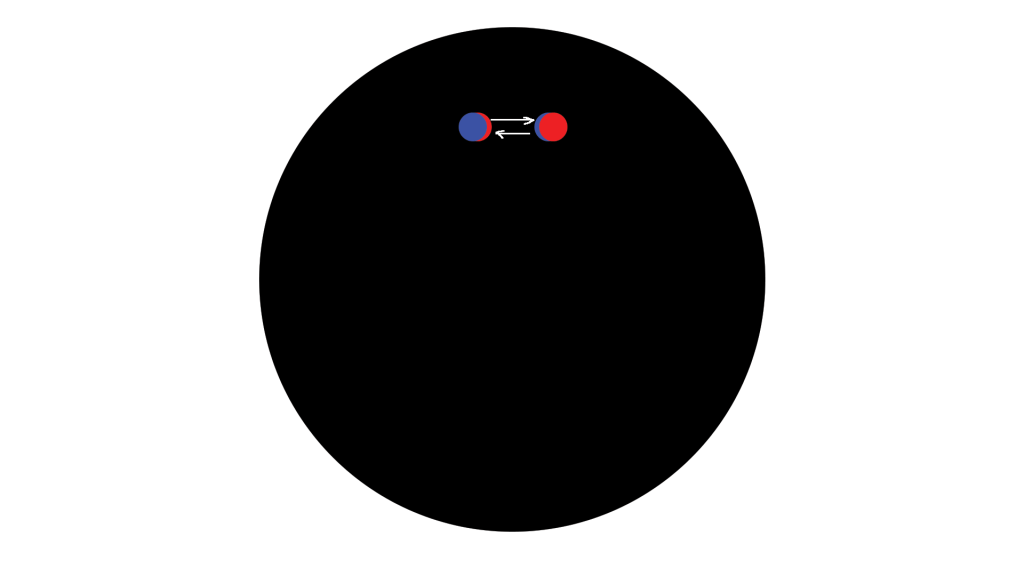
But I think if you just have a moderate interest in politics you will have realized that that almost never happens. When was the last time you saw somebody convinced by arguments when it comes to politics? If the logic model was true it should happen all the time. It should happen so much so that over time the left-right divide would be gone. But that didn’t happen. Otherwise there wouldn’t be this blog post. There is still a left-right divide and over time that divide became deeper, not smaller.
In the righteous mind Haidt introduces the intuitionist model of morality. It is a different explanation of how the brain works. According to the model whenever we are confronted with something that we consider evil or immoral, something that could be a racist joke or a gay character, before we start to think about it, we react emotionally first. We have gut intuitions, towards anything we consider morally wrong. Before we think about it intellectually, certain things just feel wrong. They feel evil and they do so independently of any argument we can make in favor of them or against them. The way that we would phrase it today is we would say that something triggers us.
Based on that trigger we decide if something is right or wrong. And after we made that decision then we try to find ways to justify why something would be right or wrong. The difference is we’re not making decisions based on logic. We come to a conclusion emotionally first, and then the arguments we make are just a way to put these emotions into words. Emotions come first, logical reasoning second.
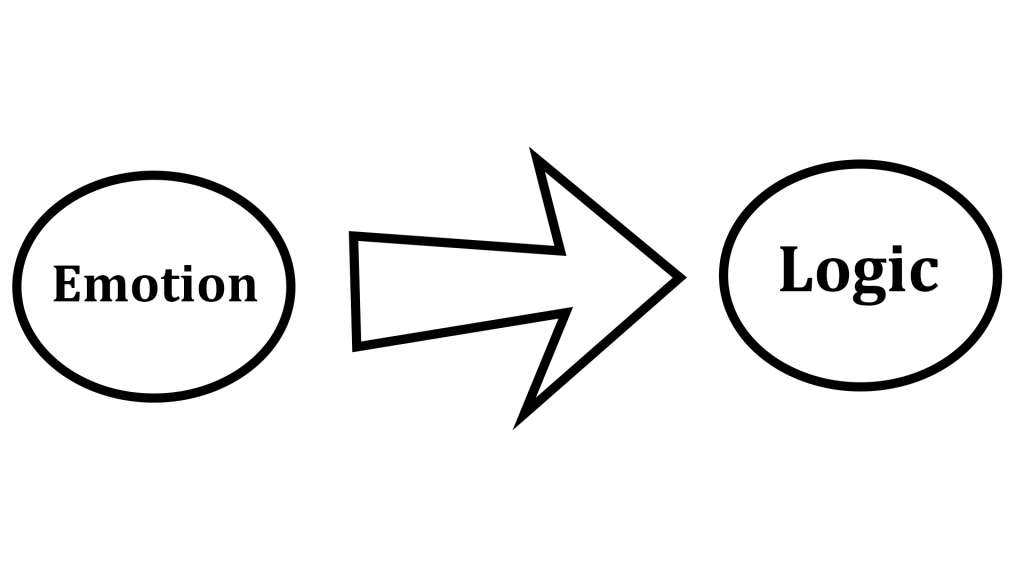
A short disclaimer about this line: “Emotions come first, logical reasoning second.” I plan on using this line a lot in this text and I know that if you are familiar with the book you are going to notice that that is not the exact line from the book. The actual line is “intuitions come first, logical reasoning second” and I know of that. I am aware that Jonathan Haidt deliberately chose the word intuition and that in the book he does explain what the difference between an emotion and an intuition is. There IS a difference. However for the purposes of this text the difference is not going to matter. That is why I’ll stick to “emotions come first”. Now let’s apply this theory to our examples.
If the intuitionist model is true, what that would mean is that we’re not against racist jokes or gay characters because they are dehumanizing or because they are grooming. What happens is that when we encounter a racist joke or a gay character, we get this ick. It feels wrong. We get a strong feeling that this is evil. Today we would say that this “triggers” us. We make our decision based on that feeling and only after we made the decision do we then start looking for arguments. And as we look for arguments we come up with the fact that they are dehumanizing or grooming.
Now one thing that’s important to mention here is that when I say we make decisions based on emotion that doesn’t mean that these emotions are arbitrary. There is of course always a reason why we feel this way. But what I want to focus on and what’s going to be very important later is whether we see humans as fundamentally emotional creatures or rational creatures.
Another thing that’s important is that there is a reason behind the emotion, but the argument we give to justify why we feel this way, might not be the actual reason why we feel this way. We get the feeling and then we look for any argument we can use to justify that feeling. That argument can be completely different from the actual source of the emotion. Now you’re probably wondering if there is any proof for the intuitionist model. And there is.
The book The Righteous Mind goes over many different ways how you can show that this is how humans make decisions. I’m not going to go over all of them. I’m just going to show you one of the ways that you can prove this. I believe this is the best and the most convincing way. And that is: You can actually feel the trigger. You can actually feel it when you encounter something immoral. That there is a gut intuition that wants to tell you that this is wrong. At the start of the book Jonathan Haidt gives us a couple of examples for things that elicit this trigger particularly strongly. These are those examples.
“A families dog was killed by a car in front of their house. They have heard that dog-meat was delicious so they cut up the dogs body and cooked it and ate it for dinner. Nobody saw them do this.”
“A man goes to the supermarket once a week and buys a chicken. But before cooking the chicken, he has sexual intercourse with it. Then he cooks it and eats it.”
Do you know what I mean? Could you kind of feel this? Could you feel the trigger? Could you feel that there was something deep inside you that wanted to tell you that this is wrong? That this is evil? Could you maybe even feel how it happened before we even had time to think about this? Before we even had time to think about arguments? How it happened immediately after we read the stories?
The first time I heard the stories I could also feel something else. I don’t know if I’m the only one who felt this way – maybe you did too. But what I felt was that I was already trying to come up with arguments. I was already trying to look for a reason for why it is wrong. As soon as I got the trigger the first thought that popped in my head was this ick, this “This is disgusting”. The second thought was “This is morally wrong, because this is unhygienic.”
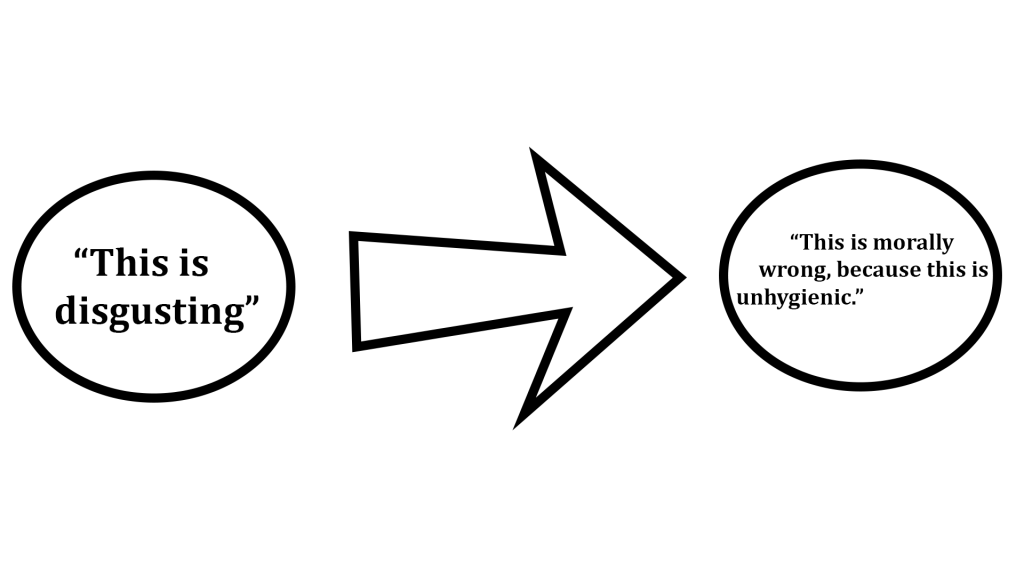
The reason I call this weird is because technically I didn’t need to come up with an argument. It’s not like I was in a debate. I was at home reading the stories. As far as I know there is nobody willing to defend having sex with a chicken. I could have just said “it’s wrong because it feels wrong” and then left it at that. But my brain almost automatically decided that I need to have a reason for that.
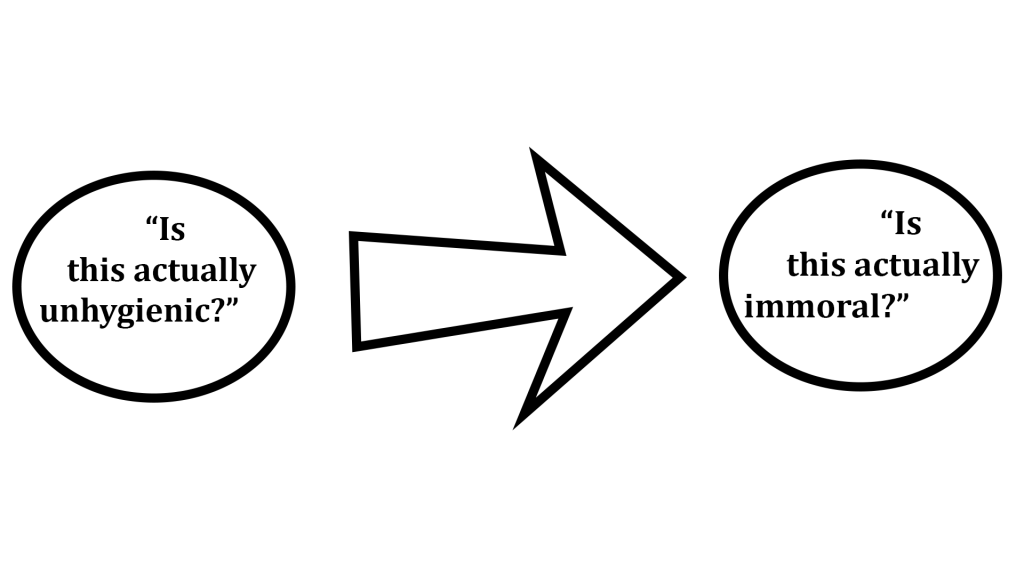
And the other thing that’s interesting is that it didn’t work like the logic model. If the logic model was true what we would expect is that when I hear these stories what would happen is: I hear about a man having sex with a chicken: → I start thinking. → I start asking myself “Is this actually unhygienic?” I know that it seems unhygienic, but on the other hand there are people who eat semen, and nothing bad happens to them. I should have figured out if this is unhygienic first and then come to a conclusion. And then should I have started feeling something. But it didn’t work like that. I felt something immediately after I read the stories. Before I started thinking about them. It was feelings first and then came the arguments.
Now there are going to be people who are going to read these examples and are not going to feel anything. That is actually something that’s going to be very important later. That different people have different triggers. If you are one of those people maybe think about something that you consider immoral. Think about does it give you a gut reaction immediately or do you have to reason about it first? And I think most people are going to come to the same conclusion. That our feelings react first and then we find an argument.
Now let’s also apply this idea to our examples. To racist jokes and to gay characters. The question is: “Is our disagreement on these issues based on different arguments or based on the fact that liberals and conservatives have different moral triggers?” Maybe you remember the last time you heard a racist joke or you saw a gay character in a kid’s film. Did that gave you the same trigger? Did that feel the same as when we read the story of the family eating the dog? If that is true, then the left-right-divide is not about arguments but about feelings.
I can’t prove that you made those decisions based on emotions, but what I can prove is that there are at least some people for whom racist jokes or gay characters in movies are a trigger. How could one prove that? I can prove that because some people talk about how these things make them feel.
And listen to what they’re saying. They’re not using the term moral intuition but they’re clearly describing the same feeling that we’ve been talking about.
Source: https://youtu.be/NKNjRF55YAs?si=BqjxFIBn7ikACl-B
Time: 2:55
When I first saw this my reaction was just “Ooh Ooh” It wasn’t a laugh it was more like a “Ooh”. You guys are you’re just trying to be bigoted assholes, right?
When he says that he went “Ooh!” that is a moral intuition. It’s an emotional reaction that happened immediately after he saw the picture.
source: https://youtu.be/2Q9siWyJ58s?si=Ea5YeoVsJRpAlajZ
Time: 5:30
I’m going to be absolutely honest with you, this makes me uncomfortable. I don’t even know why I can’t explain why. That’s the thing. We’re all a victim to our prejudices, we’re all going to have an instantaneous reaction, and my first reaction is “ew why”.
This is an aspect of this that we’re going to talk a lot about later. That sometimes we get this feeling but we ourselves don’t know why.
So if they feel this way they’re probably not the only ones in the world who do. There are probably other people who also feel this way. And if emotions come first, logical reasoning second, other people would find different arguments to justify those feelings. And if all of that is true then that would mean that the ideologies of liberalism and conservatism would just be a way to put these feelings into words.
I know that when we first hear about this idea that we’re not making decisions based on logic it sounds insulting. We like to think of ourselves as purely rational. That we can look at these things without emotions. We look down on people who act emotionally. But consider the opposite. Think about somebody who had no emotions. Somebody who could hear about murder and rape and wouldn’t feel anything, who wouldn’t have any kind of emotional reaction. Would you want that? Would you want somebody with no moral emotions? Or would you not say that it’s better that we’re guided by our emotions?
I notice that when I talk to people about this at first they’re apprehensive about this idea that we make decisions based on emotions. But after a while we figure out that they know this feeling, they know the trigger that we’re talking about. They just haven’t called it moral intuition before. They called it something else. Some people call this a moral compass. Other people call this conscience. Other people call this vibes. Other people call this an inner voice that tells us what is right and wrong. So if you still don’t believe in moral intuitions maybe think for a moment if you know this feeling too. Maybe you just know it under a different name.
Now the next question is: “If logical arguments are just a way for us to put these feelings into words, what happens if somebody can debunk those arguments?” In another study Jonathan Haidt gave people moral hypotheticals. He asked them if somebody did something wrong, and whatever their answer was he would then try to argue against that answer. He would try to find reasons for why they are wrong. This is an interview from one of those studies:
“Julie and Mark, who are sister and brother, are traveling together in France. They are both on summer vacation from college. One night, they’re staying alone in a cabin near the beach. They decide that it would be interesting and fun if they tried making love. At the very least, it would be a new experience for each of them. Julie is already taking birth control pills, but Mark uses a condom too, just to be safe. They both enjoy it, but they decide not to do it again. They keep that night as a special secret between them, which makes them feel even closer to each other. So, what do you think about this? Was it wrong for them to have sex?”
“Yeah, I think it’s totally wrong to have sex. You know, because I’m pretty religious, and I just think incest is wrong anyway. But I don’t know.”
“What’s wrong with incest, would you say?”
“Um, the whole idea of, well, I’ve heard, I don’t even know if this is true, but in the case, if the girl did get pregnant, the kids become deformed most of the time in cases like that.”
“But they used a condom and birth control pills.”
“Oh, okay, yeah, you did say that.”
“So there’s no way they’re going to have a kid.”
“Well, I guess the safest sex is abstinence, but, um, uh, I don’t know. I just think that’s wrong.
I don’t know. What did you, what did you ask me?”
“Was it wrong for them to have sex?”
“Yeah, I think it’s wrong.”
“And I’m trying to find out why, what you think is wrong with it.”
“Okay, um, well, let’s see, let me think about this. How old were they?”
“They were college age, around 20 or so.”
“Oh, oh, I don’t know. I just, it’s not something you’re brought up to do. It’s just not, well, I mean, I wasn’t. I assume most people aren’t.I think that you shouldn’t, I don’t, I guess my reason is just that, uh, you’re not brought up to do it. You don’t see it. It’s not, um, I just, I don’t think it’s accepted. That’s pretty much it.”
“You wouldn’t say that anything you’re not brought up to see is wrong, would you? For example, if you’re not brought up to see women working outside the home, would you say that makes it wrong for women to work?”
“Oh, well, oh gosh, this is hard. I really, um, I mean, there’s just no way I could change my mind, but I just don’t know how to, how to show what I’m feeling, what I feel about it. It’s crazy.”
So we’re not going to talk about whether incest is wrong. I’m just going to assume that the majority of people reading this already agree that it is. What we care about are the types of arguments that she makes. That is important for politics because the way our brain works when it tries to argue against incest is the same way our brain works when it tries to argue about any other moral issue. About racist jokes for example or gay characters in kids movies or any other political issue that you care about. Whatever the topic is, the underlying machinery of the brain works the same way. In fact I’ve had this exact conversation many times, only difference being that we were not talking about incest but something else.
I know exactly what it’s like to be the interviewer in that scenario. You ask somebody “Why do you believe this?” They give you a reason. You debunk that reason. They give you another reason. You debunk that too. But no matter what you say, no matter what kind of arguments you make, nothing changes their mind. And at the end sometimes they even say something like “There is no way I can change my mind.”
I also know exactly what the girl felt like in that moment. I had the exact conversation to when I was in the position of the girl. There was something I tried to argue for, that I just knew it was true. I didn’t know why, but I just knew it was true. I knew it, I felt it. But for some reason I just can’t find the right words to explain it. Whenever I say something there is somehow something wrong with it. And I’m sitting there wondering “This is so obvious. But why can’t I find the right words too say it? Why can’t I explain something that is so obvious?”
So let’s look at how she tries to argue against incest. The first thing she says is “I believe incest is wrong because it creates deformed children.” But that is not the real reason that she believes that. This is something that might be a hard pill to swallow but we don’t know why we believe things ourselves. If that was the real reason she would change her mind as soon as that reason gets debunked. He could show that in this case it doesn’t produce deformed children so in this case it shouldn’t be wrong. But the real reason that she thinks it’s wrong is this feeling. The deformed children are just a post-hoc-rationalization.
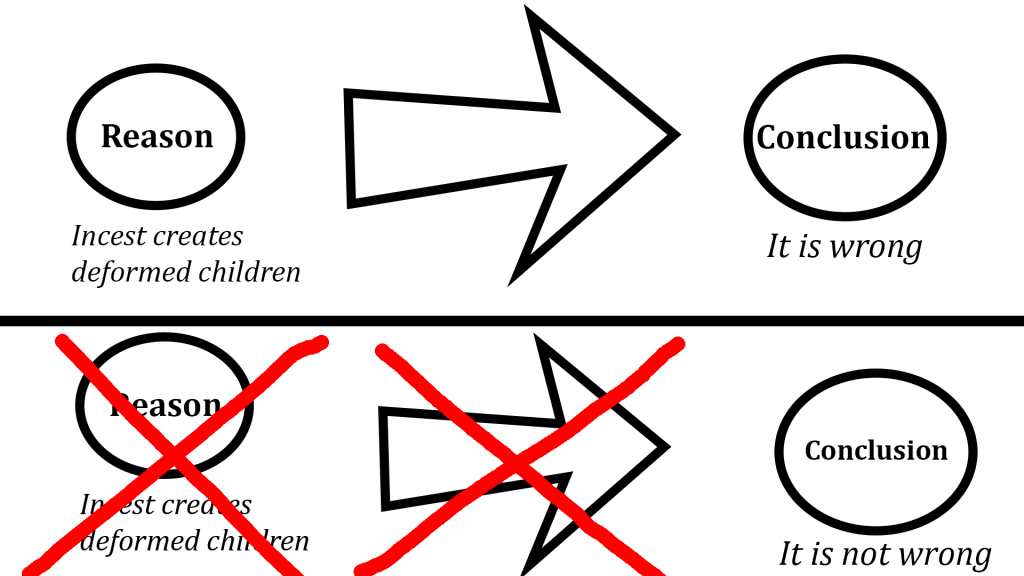
When that argument gets debunked she moves on to the next argument. “It’s not something you’re brought up to do.” And then he makes the point that if you follow that logic that you’re not supposed to do something you’re not brought up to do then women shouldn’t be working. Which is not something that she believes.
This is another aspect of the intuitionist model. Every argument we make is there to justify that emotion in that moment. We’re not trying to apply the same argument in other situations. In those situations we may feel something else. If the logic model was true that is actually what we would expect. Every time we encounter a situation where we have to judge whether something is right or wrong we ask ourselves the same questions. “Does it create deformed children? Is it something you’re brought up to do?” And we decide whether something is right or wrong based on our answers to those questions. But this is not how humans work.
First we get the feeling. Incest gives us a bad feeling and then we try to come up with a reason to justify that feeling. One possible way to justify that would be to say that it’s not something you’re brought up to do. We use that argument to justify that feeling. Women working on the other hand does not give us a bad feeling and because it doesn’t give us a bad feeling there is no reason to ask ourselves “Does this create deformed children? Is this something you’re brought up to do?” Only if it’s prompted by an emotion do we even consider that question.
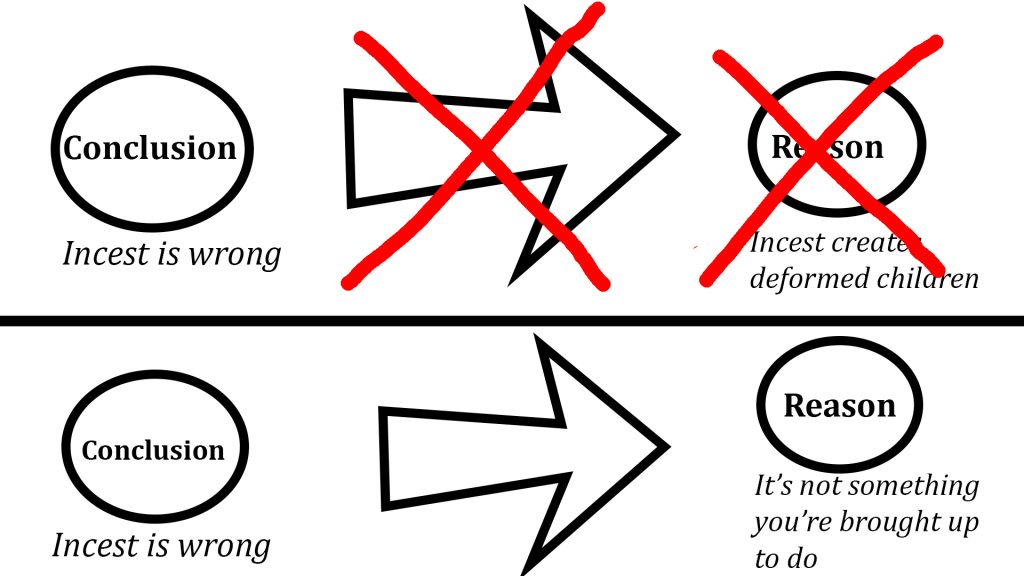
I think what this does is it destroys the idea of consistent principles. Before working on this I looked online for other psychological explanations for the left-right divide and most of them work more or less like this: There are certain ideas that form the core principles of liberals and conservatives. Those ideas have the logical consequence that something else is true and if that is true then something else is true and so on and so forth. And every single political position of liberals and conservatives is the logical conclusion of these core principles. And in my experience these kinds of explanations never work. They can never adequately explain every single position of liberals and conservatives. There is always something that they believe where I can show that what liberals believe actually makes more sense as a logical conclusion from the supposed conservative principles and what conservatives believe as a logical conclusion for the supposed liberal principles.
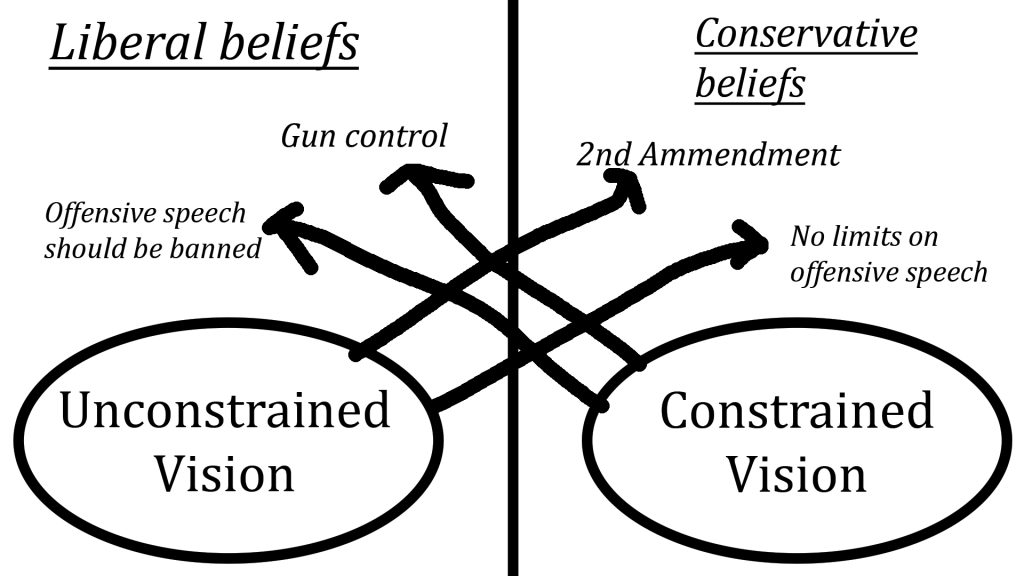
I think the most famous example of this would be Thomas Sowell. Thomas Sowell came up with the concept of the constrained vision and the unconstrained vision. Liberals operate under the assumption of the unconstrained vision. They start with the core principle that human nature is in essence good, that we are good people at heart. What follows from that is that the best thing for humanity to do is to remove all constraints. Let people do what they want. Don’t give them too many rules and if we do that society will get better automatically. Conservatives start with the core assumption that human nature is in essence evil. He would call it selfish but in my opinion these two are the same. And that is why we need constraints. Examples for such constraints would be the rule of law, experience and tradition. And the idea is that everything that liberals and conservatives believe is a logical conclusion from those core assumptions.
Now I wouldn’t say that he’s entirely wrong about that. There are indeed a lot of beliefs of liberals and conservatives that you can explain that way. That makes sense as deriving themselves from the idea of human nature being good or evil. But there were just as many liberal and conservatives beliefs that would contradict that. Where it would seem that liberals follow the constrained vision and conservatives follow the unconstrained vision.
One example would be offensive speech. This is an area where liberals want constraints. You can even say that they want constraints in the form of tradition. This is where conservatives want things to be unconstrained. Another example is gun control. Liberals in general want constraints on gun ownership. Conservatives believe that the best way to deal with gun violence is if everybody has a gun then if a shooting happens there will be a good guy with a gun who is going to prevent it. To me that sounds a lot like the unconstrained vision. There are good guys. If we give people the freedom over time they’re going to do the right thing. Constraints when it comes to guns are tyrannical.
Also have you heard this idea that racism is part of human nature? That this is something ingrained in us? That we have these unconscious biases that make us treat people with different races differently and that we have to overcome these biases. Maybe the rule of law or experience or tradition may help us overcome these biases. According to this model is this something that liberals believe or conservatives believe? If human nature is racist that would contradict the idea that human nature is good. So liberals shouldn’t believe that. But in practice it’s actually more liberals who believe that than conservatives.
I think what happened is that Thomas Sowell heard a bunch of arguments from liberals and conservatives and he asked himself what is the consistent true line between all of these arguments? What do all of them have in common? And then he tried to derive a consistent ideology that would encompass all of these ideas. And he even did a very good job with that. For a lot of these ideas that is the consistent true line. The problem is that human beings don’t work that way.
We don’t make decisions based on ideas or principles. We make decisions based on emotions. If somebody says that human nature is good or human nature is evil that is an expression of how they felt in that moment. That doesn’t mean that they believe this all the time. That doesn’t mean that when they’re in another situation when they have to argue something else they won’t say something else. Perhaps a less kind way to say this would be to say that we are hypocrites.
It’s not a nice way to say this but it’s true. Human nature is hypocritical. If you define hypocrisy as changing our beliefs to suit the situation or completely abandoning our beliefs when they are no longer useful. We don’t like to think of ourselves this way but that’s what humans do. I think if you just have a modest interest in politics you’ve come across liberals or conservatives being accused of hypocrisy on almost any issue. You can call them that and most of the times the accusations are true because that is the way that all humans are. We don’t make decisions based on principles. We are not logically consistent. We are emotionally consistent.
Consistent with our beliefs according to what we feel. And now that we know that everybody is a hypocrite an interesting question arises. I’ve said I’m going to reserve my answer for the question of who is correct liberals or conservatives for the end of this blog post. But I think that question is one that I can answer now. And I think I’m going to be able to prove my answer.
The question is: Who is more hypocritical? Liberals or conservatives? I think I know the definitive answer to that. And that is they are both equally as hypocritical. And by that I don’t just mean that if you count up all the hypocrisies in aggregate that it’s going to amount to the number between liberals or conservatives. I mean that even on any given issue they’re both equally as hypocritical. Any time you accuse one side of hypocrisy the other side is therefore as well. And I think I can prove that. I’m going to prove it with an example.
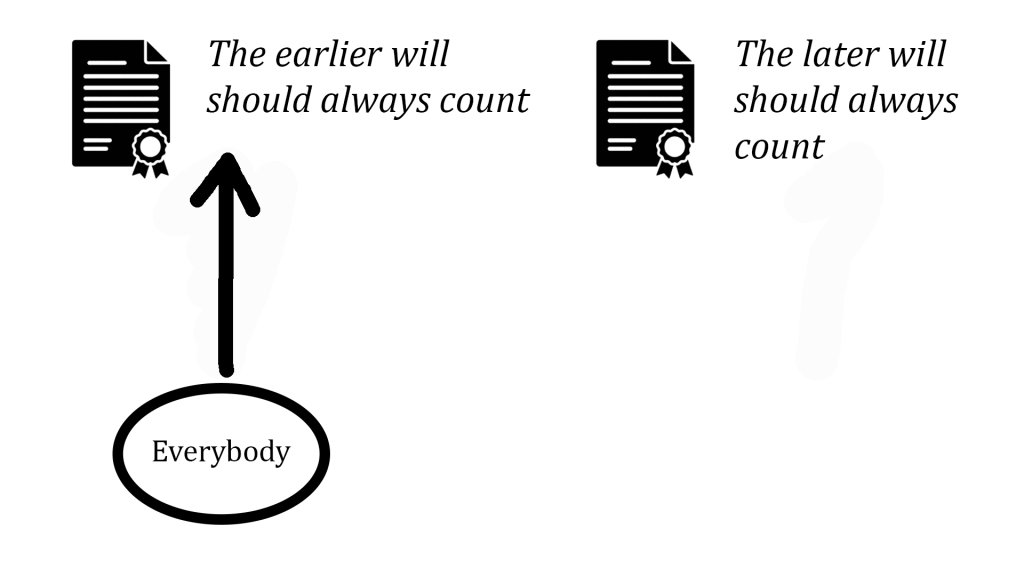
You have two brothers Alex and Tim. During their lifetime their father wrote two wills. The earlier will left everything to Alex. The later will left everything to Tim. Tim argues that they should go by the later will because that would be his most recent wish. That would override his earlier wish. Alex argues that the earlier will should count because when their father got old he became senile. He didn’t really know what he was writing. So they keep arguing. They can’t come to an agreement. Each son favors the will that favors them. One day the notary comes in. He says he’s terribly sorry. He made a mistake. He mixed up the wills. It’s actually the earlier will that left everything to Tim. And the later will that left everything to Alex. And now both of them switch their position. Alex argues that the later will should count. Tim argues that the earlier will should count.
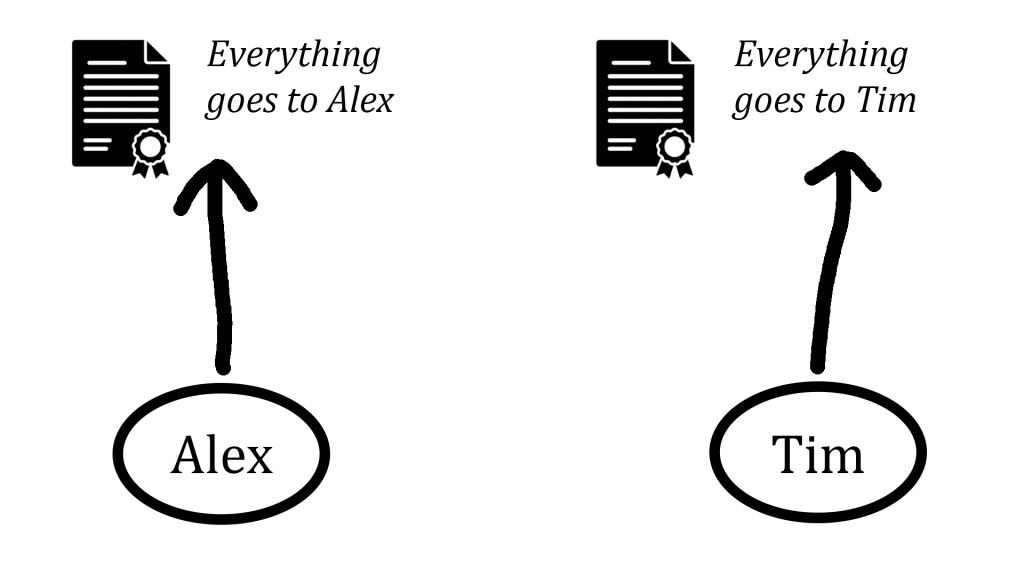
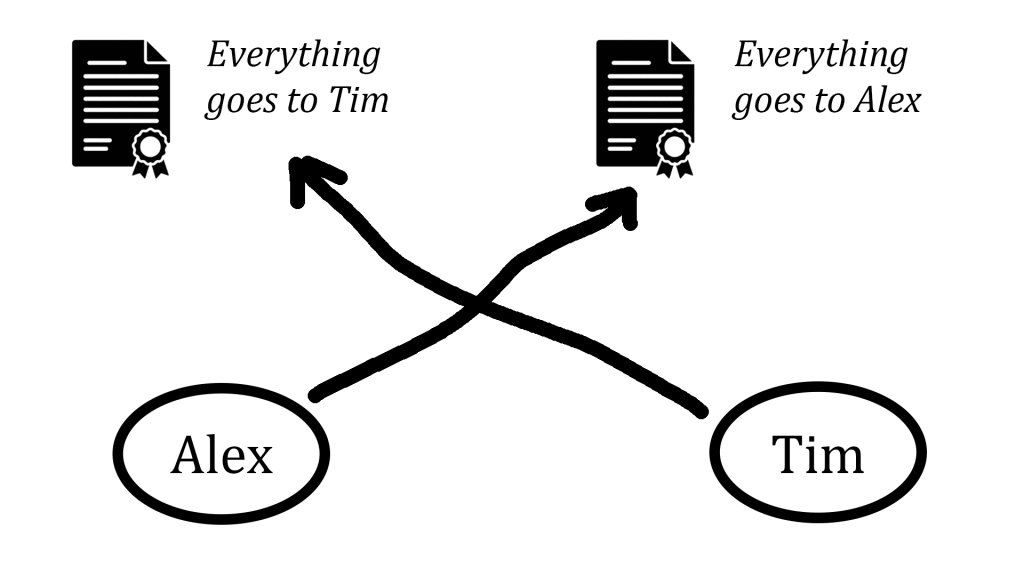
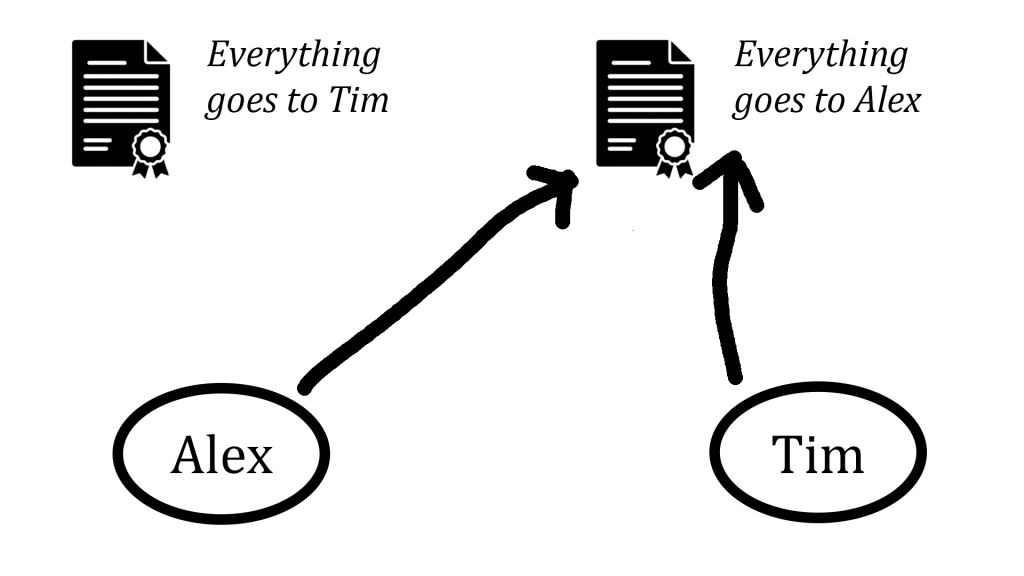
Now this is a textbook example of hypocrisy. They change their belief, as soon as the situation changes. Now which one of them do you think is a hypocrite in this situation? Obviously both of them. But let’s imagine only one of them was a hypocrite. Let’s for instance imagine that Alex is a hypocrite in this situation. And Tim consistently held true to his principles that the later will trumps the earlier will. If that was the case then they would both agree after the notary came in. They would both say that the later will should count. So what we can conclude from that is that if you know that one of the two sides is a hypocrite. And you know that there was a disagreement before the situation changed and after the situation changed. Then you know that the other side must also be a hypocrite.
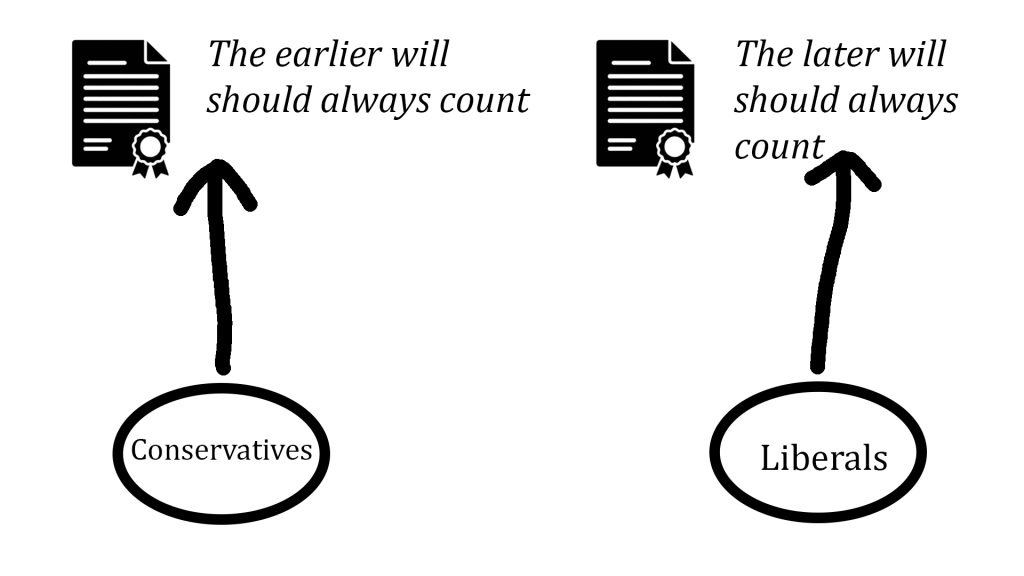
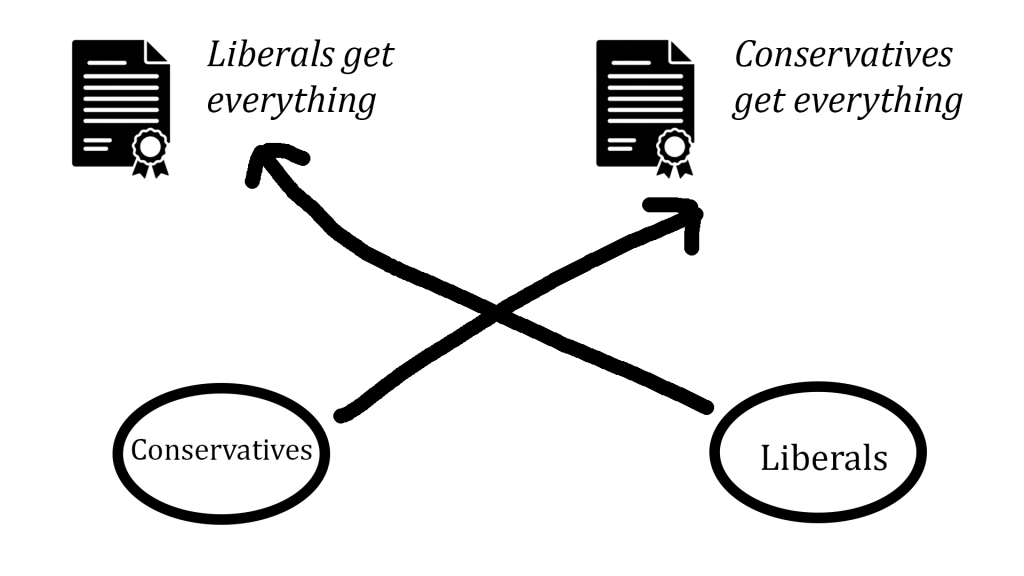
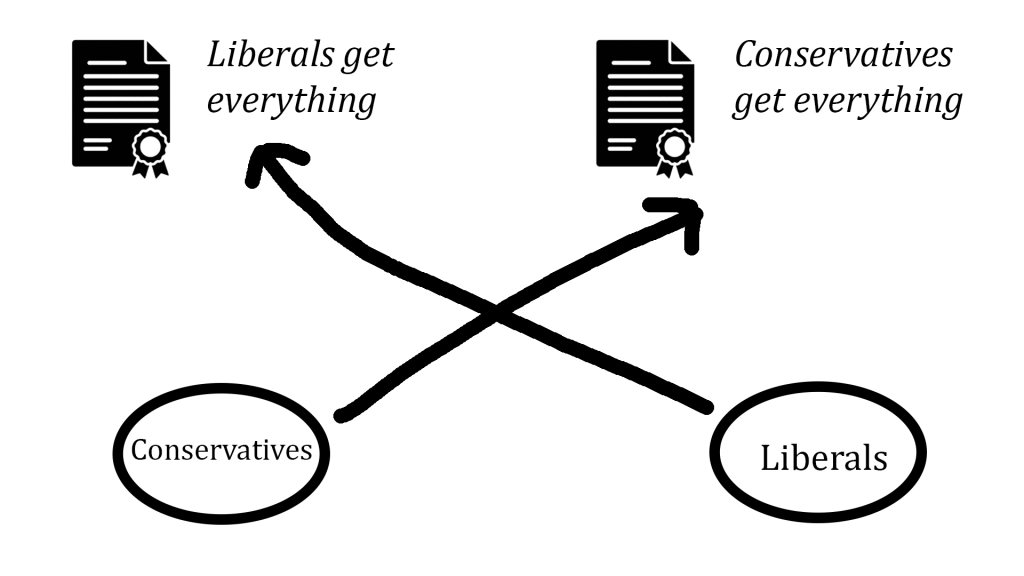
Let’s use another example. Let’s imagine we would live in a world where this stuff would happen a lot. That parents during their lifetime have two different wills. And each will leaves everything to a different child. Let’s also imagine that this issue is hotly debated. That it’s one of the moral issues of this world. That everybody has to have a position on whether the earlier will or the later will should count. Let’s imagine that each position is picked up by one of the political groups. Let’s say liberals believe in the later will or conservatives believe in the earlier will. Liberals make the argument that people’s most recent wish should trump the earlier wish. And conservatives warn about the danger of people making rash decisions when they’re later in life.
It could also be the other way around. This is just an example. Let’s imagine in this world there lives a king. And that king has two sons. And again he wrote two wills. Each one of them leaving the kingdom to a different son. The earlier will left his kingdom to his more liberal son. The later will left his kingdom to his more conservative son. What would happen in that situation? I really believe that if that would happen, people would switch their arguments to favor their favorite candidate for the throne. Liberals will now warn of the danger of people making decisions in the old age. And conservatives would now say that we should look at people’s later decision. And again in this scenario both sides are hypocrites.
And let’s again imagine a scenario where only one of the two sides acts hypocritically. Let’s say for instance conservatives change their minds. Liberals have always believed that it’s the earlier will that should count. It was their principle from the beginning. If that was the case, then liberals and conservatives would have agreed in the past. Everybody would have agreed that it’s always the earlier will that should count. If liberals and conservatives agree, we wouldn’t even think of this as a liberal or conservative position. It would just be what everybody says. We wouldn’t even call this idea liberal or conservative.
So what that means, if you accuse the other side, let’s say liberals, of being hypocrites, that means there is a disagreement now. Otherwise you wouldn’t argue with them. That means that they changed their minds when the situation changed. And that also means that there was a disagreement in the past. If there was no disagreement in the past between liberals or conservatives, you wouldn’t even be able to say what the liberal position was in the past. Because it wouldn’t have been called a liberal position. So if you accuse the other side of hypocrisy, you know these two things to be true. One side is a hypocrite. There was a disagreement before and after the situation changed. And we know that if these two things are true, the other side must therefore also be a hypocrite. Which means your side. That is why liberals and conservatives are always equally as hypocritical. If they weren’t, you wouldn’t even be able to call something hypocrisy.
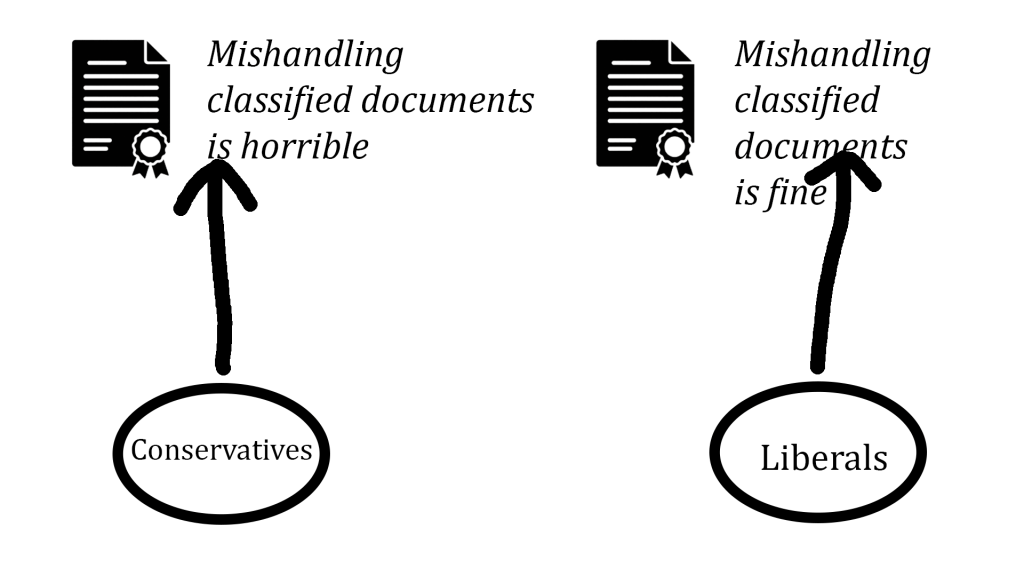
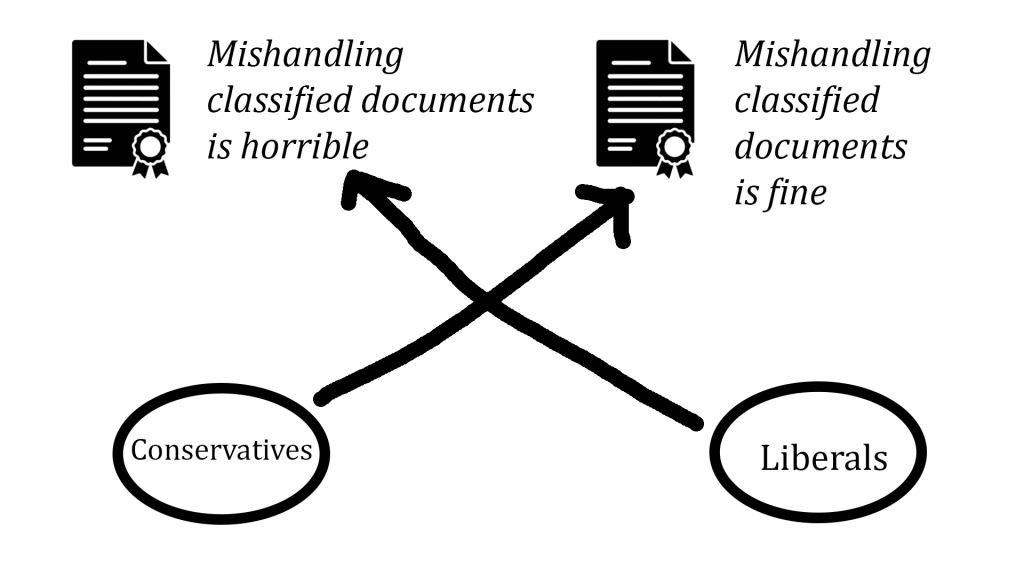
Now let’s use a more practical example. Mishandling classified documents. Should that disqualify you from becoming president? When Hillary Clinton was accused of mishandling classified documents, for the most part, conservatives said yes, that should disqualify you. And for the most part, liberals said, okay, maybe it’s not a good thing, maybe you shouldn’t do this, but it’s not enough to completely disqualify you from becoming president. A couple of years later, Donald Trump was accused of mishandling classified documents. Now liberals were the ones who said that that should disqualify you from becoming president. And conservatives were saying that it’s not that big of a deal. Now, who is a hypocrite in this situation? Liberals or conservatives? It’s either both or neither.
If that’s all you know about these two cases, that they’re both cases where somebody was accused of mishandling classified documents, then obviously it’s both sides. But “they were accused of mishandling documents.” Is a very short summary of this. These cases, of course, aren’t identical. There were many details that are different between these two cases.Now, are these additional details enough to alleviate the accusation of hypocrisy? Maybe. But if they do that for one side, they also do that for the other side.
One of the details that is different is that the FBI actually filed charges against Donald Trump for mishandling documents. You can argue that this justified disqualifying one of them from becoming president, but not the other. You can say that the fact that charges are filed shows that this is a serious issue. That it must have been worse in that case. Or you can say that the fact that charges are filed shows that this is malicious prosecution. And they were not malicious against Hillary Clinton.
The point is, if these two situations are different enough that you can’t expect people to have a consistent opinion between both of these issues, then you can’t call the other side out for being a hypocrite. They can’t call you a hypocrite either, but you can’t call them that too. If these situations are similar enough, that if you would go by principles, you should have a consistent opinion, then both sides are hypocrites. That’s why I say that whenever one side is a hypocrite, the other side must therefore also be as well.
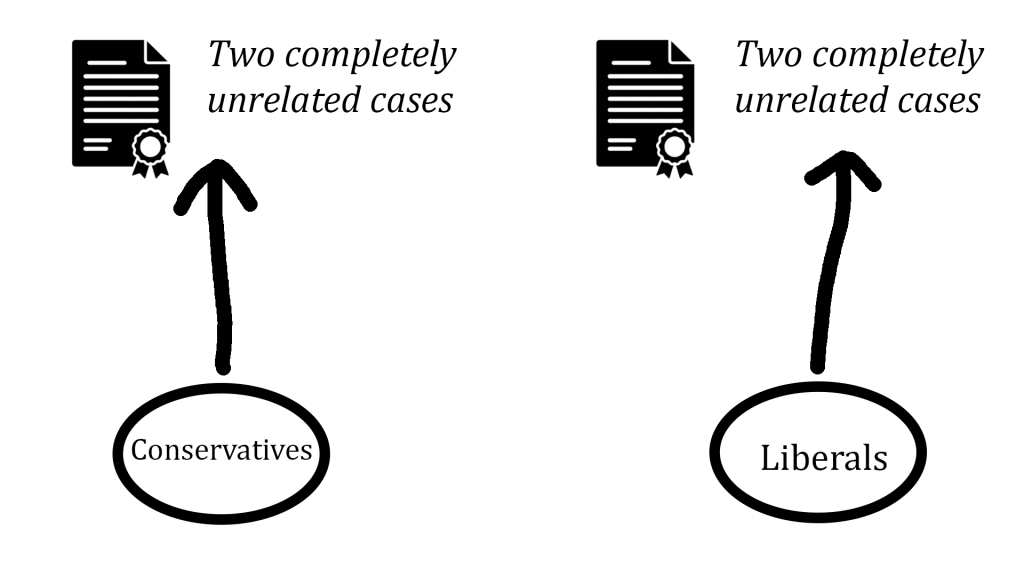
I think this is the first time we encountered a shortcoming of the intuitionist model. “Emotions come first, logical reasoning second.” We make decisions emotionally and then try to justify them logically. There is something very important missing in that equation.
Second-guessing our decisions. Second-guessing our beliefs. Criticizing our beliefs. Once we made a decision, we only look for evidence for why that decision is correct. This is why it’s so easy for us to see hypocrisy in other people. Because if we can show that they are hypocrites, that helps us. That helps us to show that we are right. But it’s almost impossible for us to see our own hypocrisy. Even though we are just as hypocritical. Even when we are just as hypocritical on the exact same issue.
Seriously, just google the word hypocrisy. Or just think of every time somebody accuses the other side of being hypocrites. In almost every one of those cases, their own side is just as hypocritical. Once somebody points it out to you, you’re going to wonder like how can they not see this? This is so obvious. And the reason they can’t see this is because the intuitionist model of morality is true. We make decisions emotionally. And logic is just there to affirm the decisions we already made. You may be heard the saying that it’s easier to see faults in other people than it is to see faults in ourselves. That is true.
And this is the reason why. Let’s talk about the last thing she said. “There is no way I can change my mind. I’m just trying to explain how I feel.”
If you remember that the original question we’re trying to answer was “why is it so difficult to convince somebody when it comes to politics?” This is why. Because the intuitionist model is true. I can count the number of times I heard anybody say in a political debate something to the effect of “That’s a good point. You convinced me.” On one hand. And that includes my entire life. That includes every debate I had offline. Online. Every bit of media I consumed. Everything I read. I watched. I listened to. And multiple people told me the same thing. That when it comes to politics people don’t change their mind.
But on the other hand. There is something else that I saw a lot. On the left and on the right. That somebody clearly doesn’t have any logical argument on their side whatsoever. But when that happens we don’t change our mind.
Emotions come first. Logical reasoning second. And if we can’t find a logical reason. We find a different reason. An illogical reason if you will. There are a couple of strategies that people like to employ when they can’t think of an argument, but they also don’t want to admit that they’re wrong:
1. We can ignore the other person. Give them the cold shoulder. Don’t listen to them. Just do something else.
2. We can pretend we don’t understand what the other person is saying. Or we can purposefully misunderstand what they’re saying. So that it seems like nonsense.
Now of course in those cases you have to distinguish between people who actually don’t understand what you’re saying. Or people who do this on purpose. Who just pretend that they’re not understanding what you’re saying. Lest you think the second group doesn’t exist. I know at least one person in my life who admitted that they did do it on purpose. They had no rebuttal. So they pretended not to understand the argument.
3. We can say “I don’t trust your source.” Keep in mind that when we’re saying that. We don’t have to look at the source. We don’t have to examine what it says. We don’t even have to know what the source is. Because trust is subjective. You can technically always say you don’t trust the source.
4. We can agree with them at the moment. We can say “You changed my mind.” But in our head we can plan to later forget what they said. That in the future we’re just going to pretend that we never said that.
And again there are people who of course actually do forget. But again I know one person who admitted that they did it on purpose. Agree at the moment. And already have in the back of your mind that a week from now I’m going to forget what they agreed to.
5. We can try to change the subject. We can try talking about something else. Just try to get away from the topic of the conversation.
6. We can insult the other person. Stop talking about the arguments. Talk about their personality. Talk about your opponent as a human. That gets us out of admitting that we’re wrong on the arguments.
7. This is one that I find particularly annoying. We can say something like “If you don’t understand that then there is no point in even talking to you.” It’s exiting the conversation but making sure that everybody knows that you would have won the debate if you had just chosen to continue. You just chose not to.
8. We can interrupt them or in some way physically prevent them from saying something.
9. We can rage quit the conversation. Find something to get angry about and use that as a pretense to leave. Then we never have to admit that we lost the debate.
10. We can say what the girl said in the interview. “There is no way I can change my mind. I’m just trying to explain how I feel.”
We can divide the processes of our brain into logical processes and emotional processes. An example of an emotional process would be something like when we watch a horror movie. When we get scared. Our brain has to do something to know when to get scared. When you see a dark hallway or something that could be the monster or when the monster attacks. We usually don’t think about this as work but our brain does something to figure this out. That is an emotional process. Another example would be when you read a letter by somebody you love. You feel something. Love or joy. Our brain has to figure out when we’re supposed to feel that. Or the simplest examples for emotional processes would be getting hungry or getting tired.
An example for a logical process would be something like writing. When we have to write something without spelling mistakes. Or doing math. That also applies to simple math. Counting is also a logical process. And the way the logical mind and the emotional mind work are very different.
One aspect of the logical mind is that the logical mind accepts the possibility that it can make a mistake. What that means is when we write something. Most of us do spell check. We look for spelling mistakes or grammar mistakes. Or when we do math. We check our math again. Even if we have to do something very simple. Something like counting. If we have to count to a large number. Most of us have to do a recount to see if we did it right the first time. Another aspect of the logical mind is that the logical mind is open to changing its mind with new evidence. For example.
I just finished writing an essay. I did a spell check. I read it again. I read it a couple of times again. And I couldn’t find any mistakes. My belief is “There are no spelling mistakes in this essay”. Then somebody comes along and says. Here, you missed something. As soon as I see the mistake. My belief goes from “There are no mistakes” to “There is a mistake”. Once a new fact is presented. I change my mind.
And again. That even applies to simple logical processes.
“Please put six plates on the table.”
“You miscounted. It’s not six plates.”
As soon as we see the table. Our belief would go from. “There are six plates on the table” to “There are not six plates on the table”.
But, You can’t argue someone out of emotions. If somebody is hungry. It doesn’t matter what argument you make. It doesn’t matter what facts you present. That doesn’t alleviate hunger. You can show them. You just ate two burgers. You didn’t do anything exhausting. Your metabolism doesn’t need that much. Logically, you shouldn’t be hungry. “But I am hungry!” The same with sleep. I can show you graphs and figures of how logically you shouldn’t be tired. You would just answer “But I am tired!” Evidence does not change emotions.
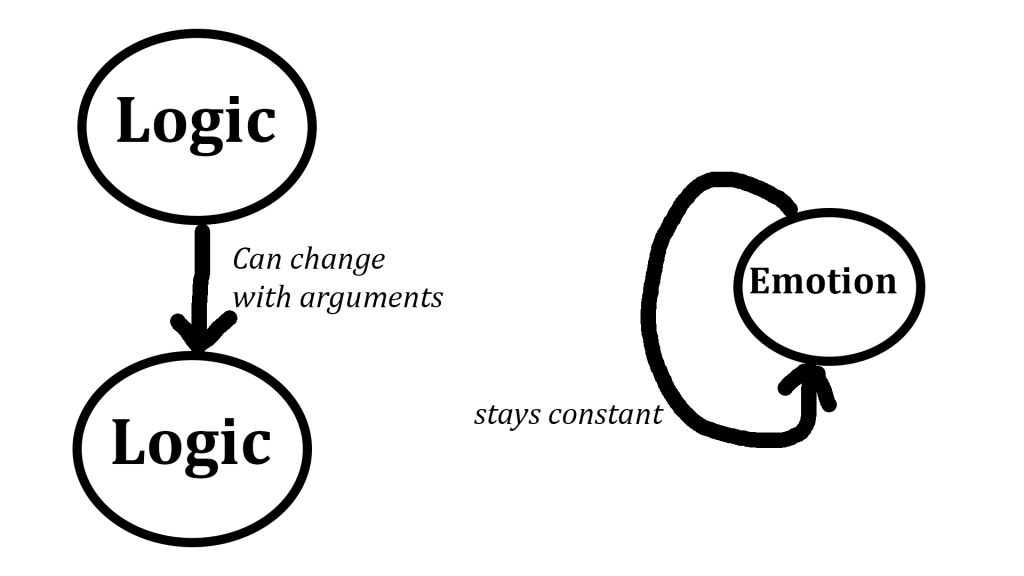
And that is basically what Jonathan Haidt was doing in the interview. The girl said incest is wrong. He tried to make arguments. Make a logical case for why incest shouldn’t be wrong. And she answered. “But it is wrong! Because it feels wrong!” If somebody is unwilling to change their mind. That is an indicator that they made the decision emotionally and not logically. And when it comes to politics. or when it comes to moral issues in general nobody ever changes their mind. On ANYTHING. When you talk to somebody about politics. The way the discussion usually works is like in the interview. One person makes an argument. The second person debunks that argument. The first person comes up with another argument. The second person debunks that. And at one point one of them uses one of the strategies to get out of the conversation.
If the logic model was true. It technically shouldn’t be like this. This is something that is so common that we all just accept it. But if we were purely logical, discussions shouldn’t go like this. I looked online if there is a logical fallacy that you can call this. But I don’t even think that there is a word for this. People just accept it as normal. The closest I could find would be moving the goalposts. But that’s not exactly what I’m talking about. What I’m going to be calling this from now on is: “Seed switching”.
This is how it works: There’s a guy who wants to plant tomato trees. He really likes to grow his own tomatoes. But he doesn’t have tomato seeds. Then his friend comes along and says. That’s okay. I have these eggplant seeds. You can use them to grow tomatoes. Of course, that doesn’t work. You can’t plant tomato trees with eggplant seeds. If you have eggplant seeds, you’re going to get eggplants.

So how does this relate to the interview? If the logic model was true. the arguments would be the seed. And the belief would be the tree that grows the seed. It grows from the seed. You can’t switch the seed and expect to grow the same tree.
Her first argument was. “Incest creates deformed children.” If that was the basis for her belief. What would grow from that is that. A. Incest is wrong. B. Procreation is wrong. If there is reason to believe that the children are going to grow up with deformities. Like if somebody has a genetic disease for instance. But what would also grow from that is that. In cases where you can’t have children. Incest is not wrong. After that gets debunked.
Her next argument is. “It’s not something you brought up to do.” That would be switching the seed. You can’t expect to grow the same tree. What would grow from that is that. Anything you’re not brought up to do is wrong. Like women working for instance. What would also grow from that is that. Once people are brought up to do this. Then it’s no longer morally wrong. If somebody debunks our argument.
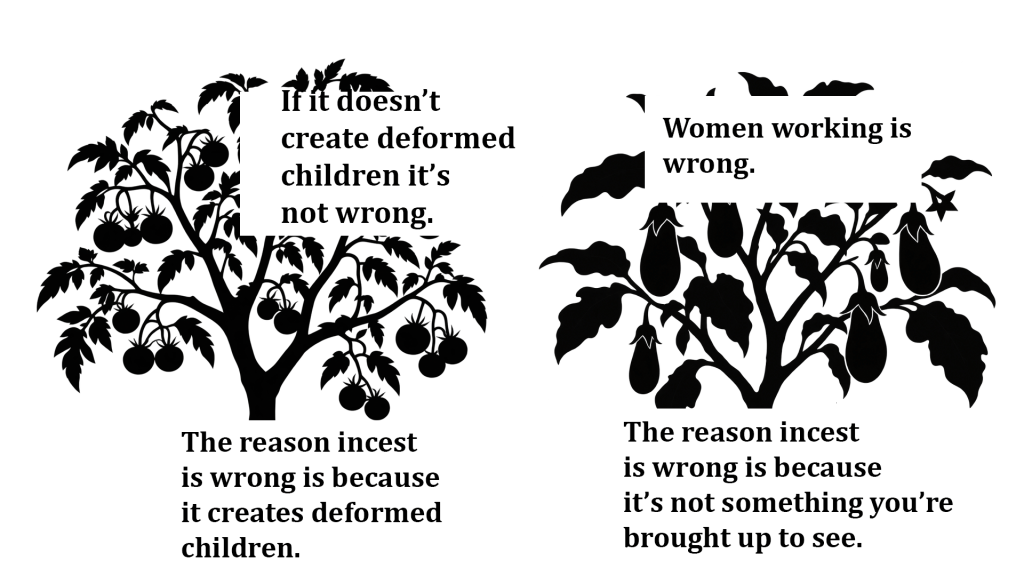
If we were purely logical, we can’t then come up with another argument. To argue for the same thing. But people do this all the time. So much so that there isn’t even a word for it. I think most people don’t even see anything wrong with that. Because that’s what everybody does. But that is not logical. The fact that everybody does it is evidence for the fact that we’re making decisions emotionally.
There is one last thing I want to mention about: The emotional mind versus the logical mind. A way to test whether something is part of the logical mind or the emotional mind is that the logical mind has limited capacity. There is only so much that it can do at the same time. One test would be to divide people into two groups. You give one of the groups a simple logical task like “Remember the number 7”. And the other group a more difficult logical task like “Remember the number 7 9 3 5 0 5 9 6 9 7 8”. If the second group has more of a difficulty doing something for instance if they make more mistakes or they take longer to do something. Then we know that that is part of the logical mind. If that’s not the case that’s part of the emotional mind. For instance: Getting scared; Getting hungry; Feeling love; or getting tired. All of these things do not become more difficult if we have to remember a larger number. They happen the same independently of the test condition.
What does become more difficult is something like writing or math. If we have a larger number in our head we make more mistakes and we take longer. One study that Jonathan Haidt did was dividing people into these exact two groups and asking them moral hypotheticals. And the result was exactly what you would expect. Figuring out if something would be right or wrong does not become more difficult and does not take us any longer if we have to remember a larger number. But what does become more difficult is when somebody asks “Why is it wrong?” That takes us longer if we do something else with our brain.
So if after all of this you are still not convinced, you still believe that you make your decisions purely logical. This is something that you can actually test at home, by yourself. The test goes: Listen to somebody you disagree with. And more specifically somebody you disagree with on moral issues. And while you listen to them do something else with your mind. You can remember a larger number. You can also do math problems while you listen to them. Or maybe you can play a video game that requires a lot of logical thinking. If you listen to that person while you are playing video games are you all of a sudden not sure if what they’re saying is wrong? And maybe find yourself agreeing with them? And then when you stop playing the video game then you know that they’re wrong? I think the majority of you will find that that is not the case.
And also: Would you even want that? Would you want somebody whose moral compass is so malleable? That they forget what right and wrong is if they’re distracted by something? But what most of you will find is that figuring out if what they’re saying is wrong does not become more difficult. But coming up with a reason for why what they’re saying is wrong, that does become more difficult. That does take more time.


Leave a Reply